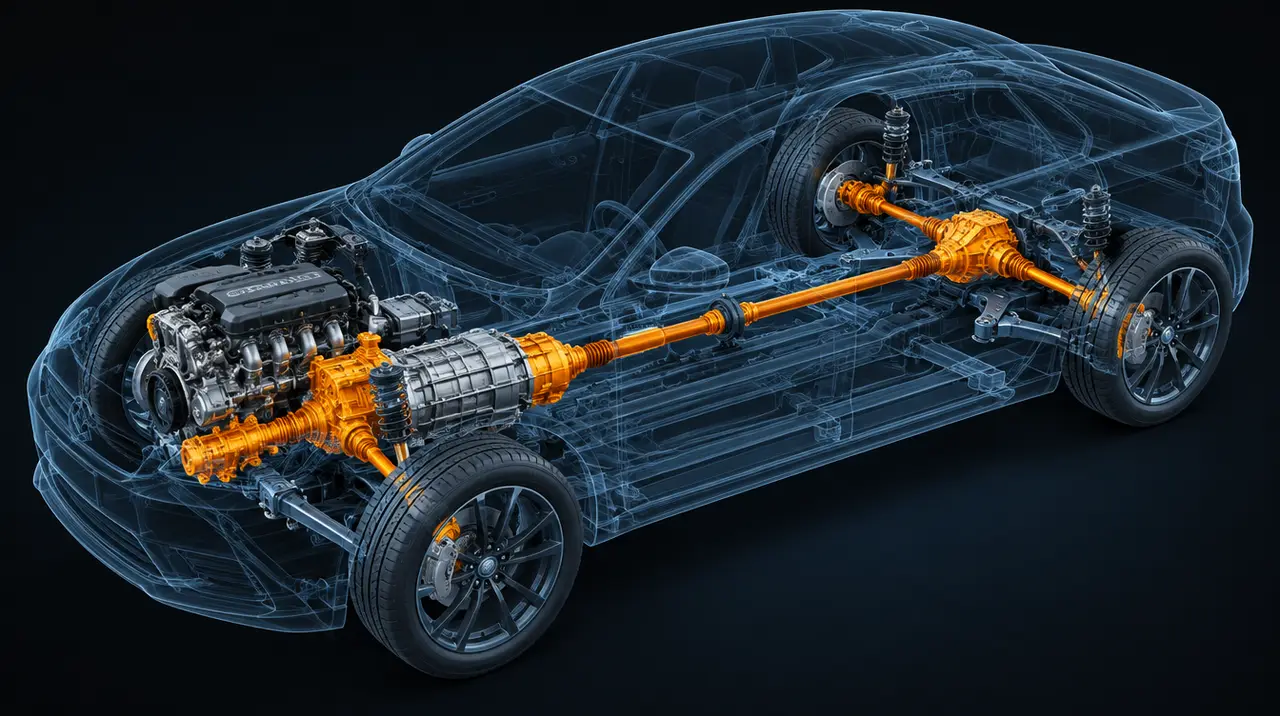
Why cars need a gearbox
A combustion engine only works well in a narrow range of speeds (roughly 1,000–6,500 rpm), but the wheels must turn anywhere from 0 to 200+ km/h. The transmission (gearbox) changes the ratio between engine speed and wheel speed: low gears give strong pulling power to start off and climb hills, high gears let the engine turn slowly at motorway speed to save fuel.
Electric motors spin efficiently from 0 to 15,000–20,000 rpm, so most EVs manage with a single fixed gear.
Types of gearboxes
Manual
You change gears yourself with a gear lever and a clutch pedal. Usually 5 or 6 speeds.
Pros
- Cheapest and simplest
- Full control, engaging to drive
- Cheap to repair
Cons
- Harder to learn
- Tiring in traffic
- Becoming rare in new cars
Automatic (torque converter)
The classic automatic: a fluid coupling (torque converter) plus planetary gear sets. Modern ones have 6–10 speeds.
Pros
- Very smooth
- Durable, handles high torque
- Great for towing
Cons
- Heavier, slightly less efficient
- Expensive to rebuild
Continuously variable (CVT)
No fixed gears: a steel belt runs between two cone-shaped pulleys that change diameter, giving infinite ratios. Common in Japanese cars.
Pros
- Very economical
- Seamless, no shift jolts
Cons
- “Rubber-band” droning under hard acceleration
- Dislikes aggressive driving and heavy loads
Dual-clutch (DCT / DSG)
Two clutches: one for odd gears, one for even gears. The next gear is always pre-selected, so shifts take milliseconds. VW calls it DSG.
Pros
- Lightning-fast shifts
- Efficient like a manual
Cons
- Can be jerky at low speed
- Clutch/mechatronic repairs can be costly
Automated manual (robot)
A normal manual gearbox with a computer doing the clutch and shifting. Cheap, but shifts are slow with a noticeable “nod”. Mostly found in budget cars.
Single-speed and hybrid transmissions
EVs use a single reduction gear. Full hybrids like Toyota’s use an e-CVT — a planetary gear set blending engine and motor power, with no belts and no clutches. Very reliable.
Gear selector letters: P park, R reverse, N neutral, D drive, M or +/− manual mode, S sport, B (in EVs and hybrids) stronger regenerative braking — useful going downhill.
Drive types: which wheels are driven?
| Drive | How it works | Pros | Cons | Typical cars |
|---|---|---|---|---|
| FWD — front-wheel drive | Front wheels pull the car | Cheap, space-efficient, good in snow thanks to engine weight over the driven wheels | Tends to understeer; limited for high power | Most hatchbacks, sedans, small crossovers |
| RWD — rear-wheel drive | Rear wheels push the car | Better balance, sporty handling, tows well | Can slide on snow/ice without electronics | BMW, Mercedes, sports cars, pickups, many EVs |
| AWD — all-wheel drive | All four wheels, managed automatically | Grip in rain and snow, fast starts | Heavier, more fuel, more expensive | Subaru, Audi quattro, dual-motor EVs |
| 4WD / 4x4 — four-wheel drive | Part-time or full-time with transfer case and low range | Real off-road capability | Heavy, thirsty; part-time 4WD shouldn’t be used on dry asphalt | Toyota Land Cruiser, Jeep Wrangler, Suzuki Jimny |
AWD vs 4WD — what is the difference?
AWD is designed for roads: it works automatically and sends power to the wheels with grip. Many are “on-demand” systems that drive the front wheels most of the time and engage the rear only when slip is detected. 4WD is designed for off-road: it has a transfer case with a low-range gear for crawling up steep, rough terrain, and often locking differentials.
AWD does not help you stop or steer. It helps you accelerate on slippery roads, but braking and cornering grip come from your tyres. Good winter tyres on a FWD car are safer than summer tyres on an AWD car.
What is a differential?
When a car turns, the outside wheels travel further than the inside wheels, so they must spin faster. A differential allows this. The downside: an open differential sends power to the wheel with least grip — so one wheel on ice can spin uselessly. Solutions include:
- Limited-slip differential (LSD) — limits the speed difference; common on sports cars.
- Locking differential — locks both wheels together for off-roading.
- Electronic brake-based “e-diff” — brakes a spinning wheel to send power to the other one.
- Torque vectoring — actively sends more power to the outside wheel to help the car turn.
Engine position
- Front-engine — the vast majority of cars.
- Mid-engine — the engine sits behind the seats, in front of the rear axle: ideal balance (supercars, Porsche 718, Corvette C8).
- Rear-engine — behind the rear axle: Porsche 911, classic VW Beetle.
- EV skateboard — battery in the floor, motors on the axles: a flat floor, a “frunk” (front trunk) and a very low centre of gravity.
Which gearbox and drive should you choose?
City + beginner
Automatic (torque converter, e-CVT or CVT) with FWD. Relaxed, affordable, economical.
Snowy winters, hills
AWD crossover or a FWD car with quality winter tyres.
Driving enthusiast
RWD with a manual or a quick DCT — the most engaging combination.